
Coated vs Laminated Fabrics: A Practical Decision Framework for Technical Buyers
Key Takeaways
This article gives technical buyers a structured way to choose between coated and laminated fabrics. Here is what matters most:
- Coated fabrics (PU solvent-based, pigment, acrylic) are typically the more cost-effective choice, delivering robust water resistance, good quality abrasion protection, and excellent chemical resistance at a lower price per metre.
- Laminated fabrics (2-layer, 3-layer, dot lamination) are the higher-performance choice where long-term waterproofness, breathability, and comfort are essential - think technical outdoor clothing, PPE, and medical products.
- The right choice depends on the balance between required performance, budget, and lifecycle cost - not just the material price on a purchase order.
Introduction: Why the Coating vs Lamination Choice Matters
In technical textiles - from outdoor apparel to industrial workwear - the decision between coating and lamination is one of the most important a product team will make. Waterproof apparel keeps users dry in adverse weather conditions, while breathable fabrics prevent sweat accumulation during physical activities. Achieving both requires understanding the trade-offs.
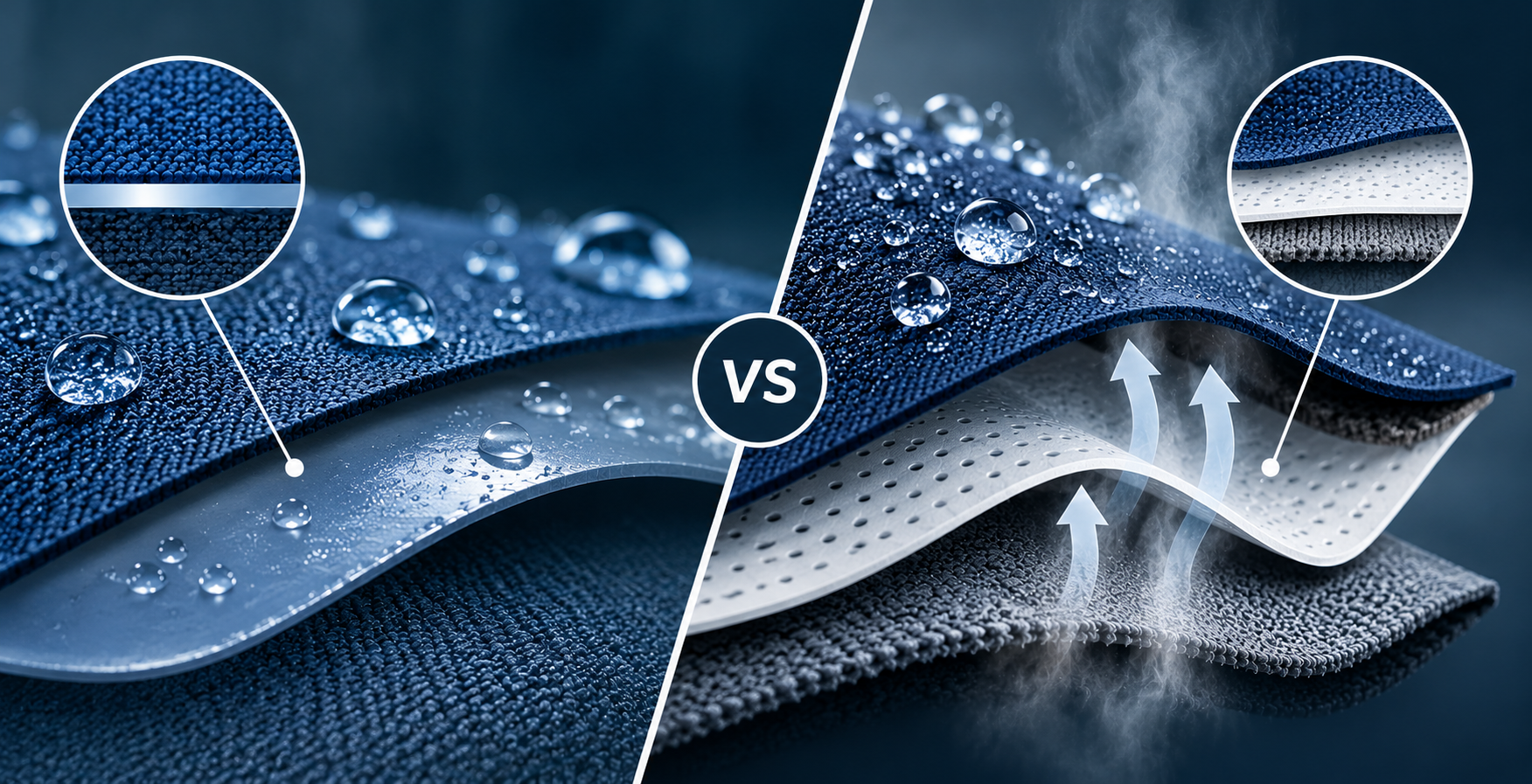
Coated and laminated fabrics differ in their manufacturing processes and performance characteristics. At its core, a coating forms an integral layer on the fabric surface, while lamination creates distinct layers with separate functions. This article frames that difference as both a business and engineering decision - covering cost, performance, brand positioning, and lifecycle value - so you can choose with confidence.
What Is a Coated Fabric?
A coating is made by applying a liquid polymer directly to the textile surface - a paste or dispersion of plastics, pigments, and additives - which is then cured or dried into a solid film. This process can be applied to substrates made from polyester, nylon, cotton, or speciality fibres like aramid.
Coated fabrics are more cost-effective due to simpler manufacturing: fewer steps, fewer materials, and less complex equipment. They are generally lighter and thinner compared to laminated fabrics, making them suitable for industrial tarps, tents, and protective workwear due to their durability. Coated fabrics also generally provide excellent chemical resistance for protective gear and industrial uses.
The key trade-off: process parameters such as coating weight, chemistry, and curing conditions strongly influence the final fabric's performance and feel. Getting best results requires close control of these variables.
Main Coating Types: PU Solvent-Based, Pigment, Acrylic
Three coating types cover most technical application areas. Each suits different priorities.
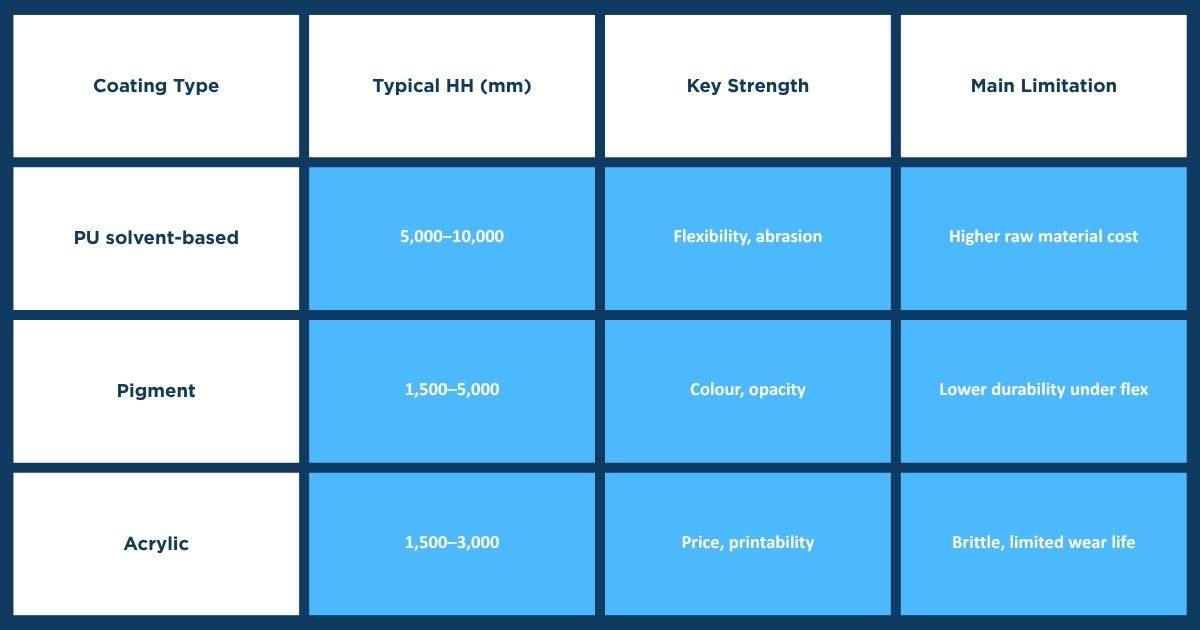
PU solvent-based coatings are the benchmark for flexible technical coatings. They offer strong water resistance (hydrostatic head typically 5,000–10,000 mm), very good abrasion resistance, and reasonable breathability. Common use cases include outdoor garments, backpacks, and protective covers where durability matters.
Pigment coatings are PU or acrylic-based systems heavily loaded with fillers. They provide opacity, colour coverage, and moderate water resistance at lower cost. Ideal for fashion rainwear, banners, and applications where appearance and price are the focus. Coated fabrics tend to excel in providing strong, non-porous barriers for a variety of these applications.
Acrylic coatings are primarily used for basic water protection rather than high-performance PPE applications. They offer a cost-effective solution with good colour stability and appearance, but typically provide lower waterproofness and durability than PU, TPU or membrane-based systems. As a result, acrylic coatings are generally limited to lightweight protective garments and products exposed to occasional rain, with typical hydrostatic head values ranging from 1,500 to 3,000 mm. For demanding PPE applications requiring long-term waterproof performance, PU, TPU or waterproof-breathable laminates are typically preferred.
What Is a Laminated Fabric?
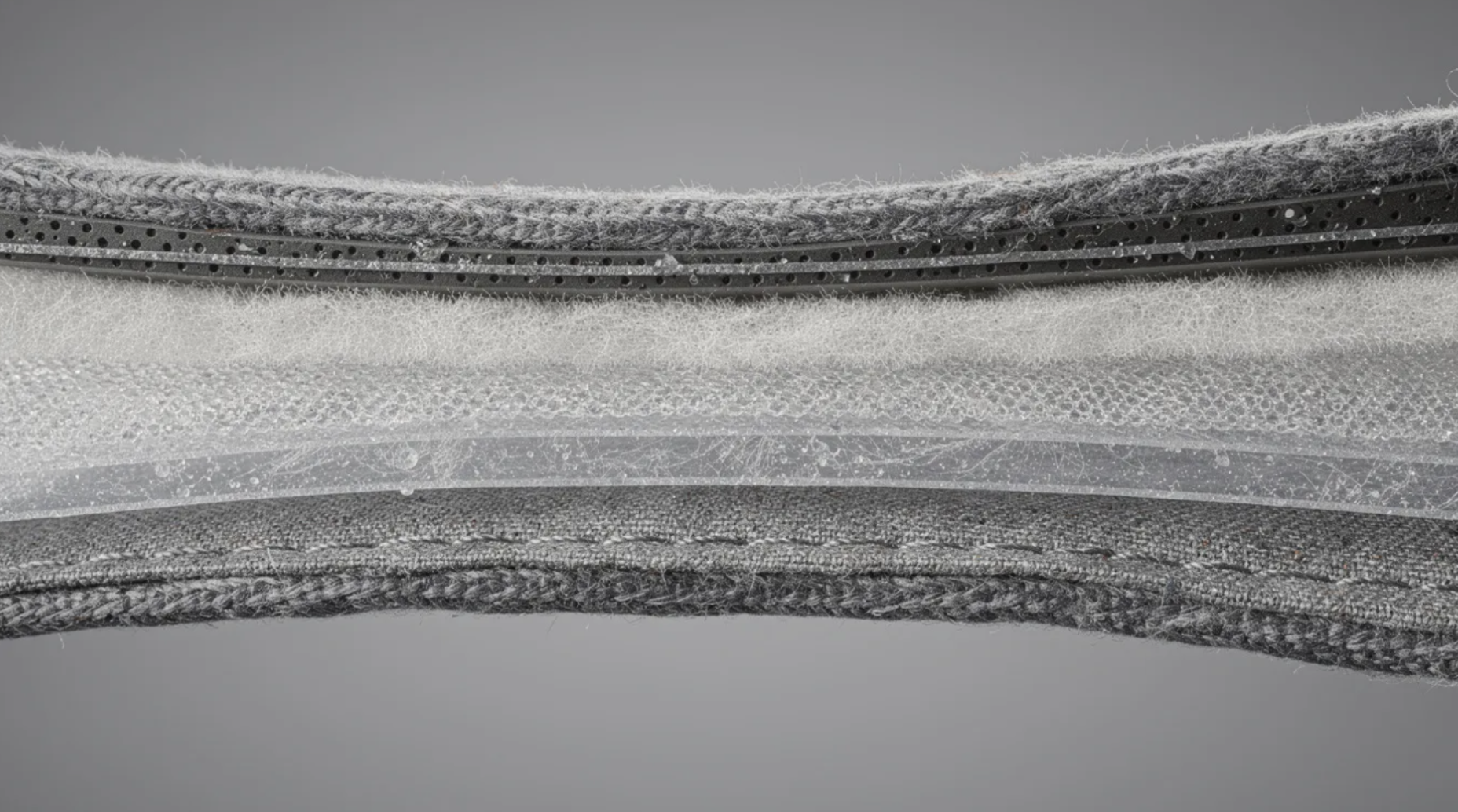
Lamination bonds a pre-formed solid film or membrane to a base textile using heat, adhesives, or pressure. The result is a multi-layer construction where each layer has a separate function:
- the outer fabric handles mechanical protection and aesthetics,
- the membrane provides waterproofness and breathability,
- and an optional lining or backing adds comfort and insulation.
Common membrane materials include PU, ePTFE (expanded polytetrafluoroethylene), and polyester-based films. Laminated films can provide waterproofness while allowing water vapor to escape - a crucial ability for active wear. Laminated fabrics offer superior durability and strength in harsh environments, and they are preferred for applications requiring comfort and moisture management in medical and outdoor products. They are typically used in high-performance outdoor apparel for waterproof and breathable requirements.
Laminated constructions are more complex and costly, but they unlock higher, more stable performance over time.
Lamination Constructions: 2-Layer, 3-Layer, Dot Lamination
2-layer laminates
2-layer laminates bond the membrane directly to the face fabric; a separate loose lining is added later. This is a good compromise of cost and comfort for corporate rainwear and casual shells. The construction is slightly heavier because of the free-hanging lining.
3-layer laminates
3-layer laminates combine an outer fabric, waterproof-breathable membrane and protective tricot backing into a single integrated construction. This creates a durable, lightweight and highly protective fabric system used in technical workwear, military apparel, PPE and premium outdoor clothing.
Depending on the membrane technology, waterproofness typically ranges from 10,000 mm to over 30,000 mm hydrostatic head, while maintaining excellent breathability. To ensure complete weather protection, garments made from 3-layer laminates are usually combined with sealed seams, preventing water ingress even during prolonged exposure to rain and harsh conditions.
Dot lamination
Dot lamination applies adhesive in a dot or grid pattern rather than as a full surface. This leaves micro-channels for moisture vapor to escape, improving breathability and drape. It is often used for bonding thin membranes to delicate fabrics in sportswear or lightweight rain garments.
The choice between constructions is driven by end-use demands, required service life, and the target price segment of the product line.

Performance Comparison: Water Resistance, Breathability, Durability
This is where technical buyers need to operate with numbers, not marketing language. In a comparative study of outdoor fabrics, laminated specimens achieved hydrostatic heads of roughly 8,700–11,200 mm, while matched coated fabrics reached approximately 5,600 mm.
- Water resistance: Breathability in coated fabrics can be limited depending on coating thickness. Laminates maintain waterproofness longer after washing and flexing. Even waterproof pants designed with laminated constructions provide sustained protection against moisture and cold over years of use.
- Breathability: The breathability of a waterproof fabric depends on the complete construction rather than on the laminate structure alone. High-performance 3-layer laminates can achieve excellent moisture vapour transport, with premium systems often delivering Ret values below 10 m²·Pa/W or MVTR values exceeding 10,000 g/m²/24h. PU-coated fabrics generally provide lower breathability, although performance varies significantly depending on the coating technology and construction. For high-activity applications such as technical workwear, outdoor apparel and protective clothing, improved moisture management can significantly enhance wearer comfort and reduce heat build-up.
- Mechanical durability: PU coatings offer strong surface abrasion resistance, but the exposed film can crack over time. 3-layer laminates protect the membrane mechanically, extending product life under backpack straps, harnesses, and industrial wear.
- Comfort and handle: Laminates - especially dot-laminated or 3-layer with soft backers - feel less plastic against the skin and produce less noise. Coated fabrics are often stiffer, which can affect perceived quality in premium consumer garments.
- Chemical and UV stability: Pigment and acrylic coatings may chalk or fade under UV exposure. PU types can be tailored for better hydrolysis resistance with careful mixing of ether-type formulations. PTFE coated fabrics can operate at 260 degrees Celsius, making them suitable for extreme thermal areas. PTFE coated fabrics are also FDA compliant for food contact applications, opening use across different industries.
Cost and Process Considerations: Coating vs Lamination
Think of this as a lifecycle cost discussion, not just cost per metre.
- Material and processing cost: Single-step coating lines are generally cheaper and faster per metre. Membranes, adhesives, and multi-pass processing make laminates inherently more expensive - but with measurably higher added value. PTFE multilayer film laminates improve production capacity significantly when viewed at scale.
- Yield and waste: Coating defects (pinholes, uneven thickness) need careful QC, especially at low cost targets. Lamination requires tight control over tension and registration; if the bond fails, scrap is costly.
- Sustainability note: Solventless lamination produces zero VOC emissions. Modern solventless laminating machines can operate at speeds over 500 meters/min, improving both efficiency and environmental results.
Decision Framework: When to Choose Coated vs Laminated Fabrics
Use this as a practical checklist for your next sourcing or product development project.
Choose coatings when:
- Applications include entry-level rainwear, bags, covers, banners, or tents for occasional use
- Priorities are low to medium price, robust water resistance, and straightforward manufacturing
- PU solvent-based for better durability; pigment or acrylic for decorative and budget products
Choose laminates when:
- Applications demand consistent high water resistance, real breathability, and longer service life
- Products include high-end outdoor garments, rescue gear, industrial PPE, or technical workwear
- A 3-layer or dot-laminated 2-layer construction is designed for the activity level and climate
The choice between coated and laminated fabrics depends on desired performance characteristics such as flexibility and durability. For safety-critical products meeting EN ISO-certified PPE standards, laminates are the recommended solutions where failure of water resistance carries health risk. In mild climates or short duty cycles, coated fabrics deliver sufficient performance at lower total cost.
Consider building an internal decision matrix - rating performance, cost, risk, and brand fit - to make repeatable sourcing decisions across your business.
FAQ: Coated vs Laminated Fabrics
Are coated fabrics always less waterproof than laminated fabrics?
Not necessarily. High-quality PU solvent-based coatings can reach hydrostatic head values comparable to mid-range laminates when new. The main difference is long-term performance: laminates with robust membranes and 3-layer constructions typically maintain water resistance better after heavy use and many wash cycles. For occasional use or low-risk environments, coated fabrics can be entirely sufficient.
How do I explain lamination benefits to non-technical customers?
Translate lamination into outcomes: "stays dry longer," "breathes better when you sweat," "lighter and more comfortable for full-day wear." Use simple visuals - cross-sections showing 2-layer vs 3-layer constructions - and real-world scenarios instead of chemical jargon.
Can I combine coatings and laminations in one product line?
Many successful brands do exactly this: coated fabrics for entry-level products, laminated fabrics for premium or professional lines. The important thing is to clearly differentiate use cases and performance promises so customers understand why one product costs more than another. Internally, align sourcing and product teams around a shared decision framework to avoid overlap.
Does a higher waterproof rating always mean better quality?
No. Extremely high hydrostatic head numbers can come with trade-offs in breathability, comfort, and noise - especially in thick coatings. Good quality in technical fabrics is a balance of water resistance, breathability, durability, and comfort relevant to the actual use case. Always check independent test data, standards compliance, and field feedback rather than relying on a single lab value.
What information should I request from fabric suppliers to compare options?
Request fabric construction details, coating or membrane type, hydrostatic head, breathability (RET), abrasion resistance, seam-sealing recommendations, and care instructions. Most importantly, ask for long-term test data - performance after a defined number of wash cycles, UV exposure hours, or flexing cycles - rather than just initial values. Consistent technical data also makes it far easier for your marketing and sales teams to position your products convincingly.
Coating or lamination: which fits your product best?
Share your application, performance targets and budget with our team - we'll help you weigh coated against laminated constructions and find the fabric that delivers the right balance of protection, comfort and lifecycle cost.
