
Durable workwear textiles: From fabric choice to industrial laundry performance
When your workwear garments start losing colour, shape or don't comply with any more certification after a few months of use, the problem usually started long before the first wash. It started with the fabric specification. This guide explains what durability actually means in measurable terms, which materials and constructions survive industrial laundry, and how to avoid the costly mistakes that lead to premature replacement.

What "durable workwear textiles" really means for your business
Durability is not a marketing buzzword. It is a financial and operational metric built on three concrete pillars: longer garment lifetime, less frequent replacement, and lower total cost of ownership over 3–5 years of service. For a facility management company equipping 200 workers, extending jacket lifetime from 18 to 36 months by changing a single fabric specification can cut annual textile spend by 40% or more.
For rental services and industrial laundries - common across healthcare, manufacturing and logistics - durability is measured in validated wash cycles. A fabric that passes 75 cycles under EN ISO 15797 but loses fit or colour at cycle 30 is not durable. ISO 15797 tests evaluate fabric durability under industrial laundry conditions, meaning the textile must retain its performance under real-world cleaning demands, not just survive on paper.
Core Performance Requirements for Modern Workwear Fabrics

Abrasion resistance of workwear fabrics ISO 12947-2
Tested via Martindale, abrasion resistance is the clearest signal of how long a fabric survives daily friction. Dense weave structures improve resistance to friction and snagging, and durable fabrics resist tearing and abrasion in industrial settings.
Strength & stability of workwear fabrics
Tear & tensile strength
Synthetic fibers provide superior tensile strength compared to natural fibers — a key reason technical blends dominate in demanding workwear applications.
Dimensional stability
Shrinkage below 3% in both warp and weft after industrial washes is a strong benchmark for fabrics that need to keep their fit through repeated laundering cycles.
Colourfastness in workwear fabrics
Colour retention under wash, light and perspiration exposure. Colourfastness depends on multiple factors working together:
Appearance and pilling resistance over time
Appearance in workwear can change over time through extensive usage and washing. Long fibers improve resistance to pilling and friction, keeping surfaces presentable well past the first wash cycle.
Performance requirements for high-risk workwear
For sectors like oil and gas, utilities and welding, high-performance fabrics protect against abrasion and environmental hazards — but only if the protective certification holds after industrial washing.
In these high-risk environments it's essential that certification remains intact and soilage is fully washed out. Otherwise, residual oil in the fabric may increase flammability and raise the risk of ignition.
Want fabrics that hold up wash after wash?
Concordia validates every durable fabric against real industrial laundry conditions — not just lab claims.
Natural vs Synthetic Materials: Choosing the Right Workwear Fabrics
No single fibre wins in every situation. Most durable workwear relies on blends optimised for both field use and industrial laundry. Choosing workwear materials means understanding each fibre's characteristics and limitations.
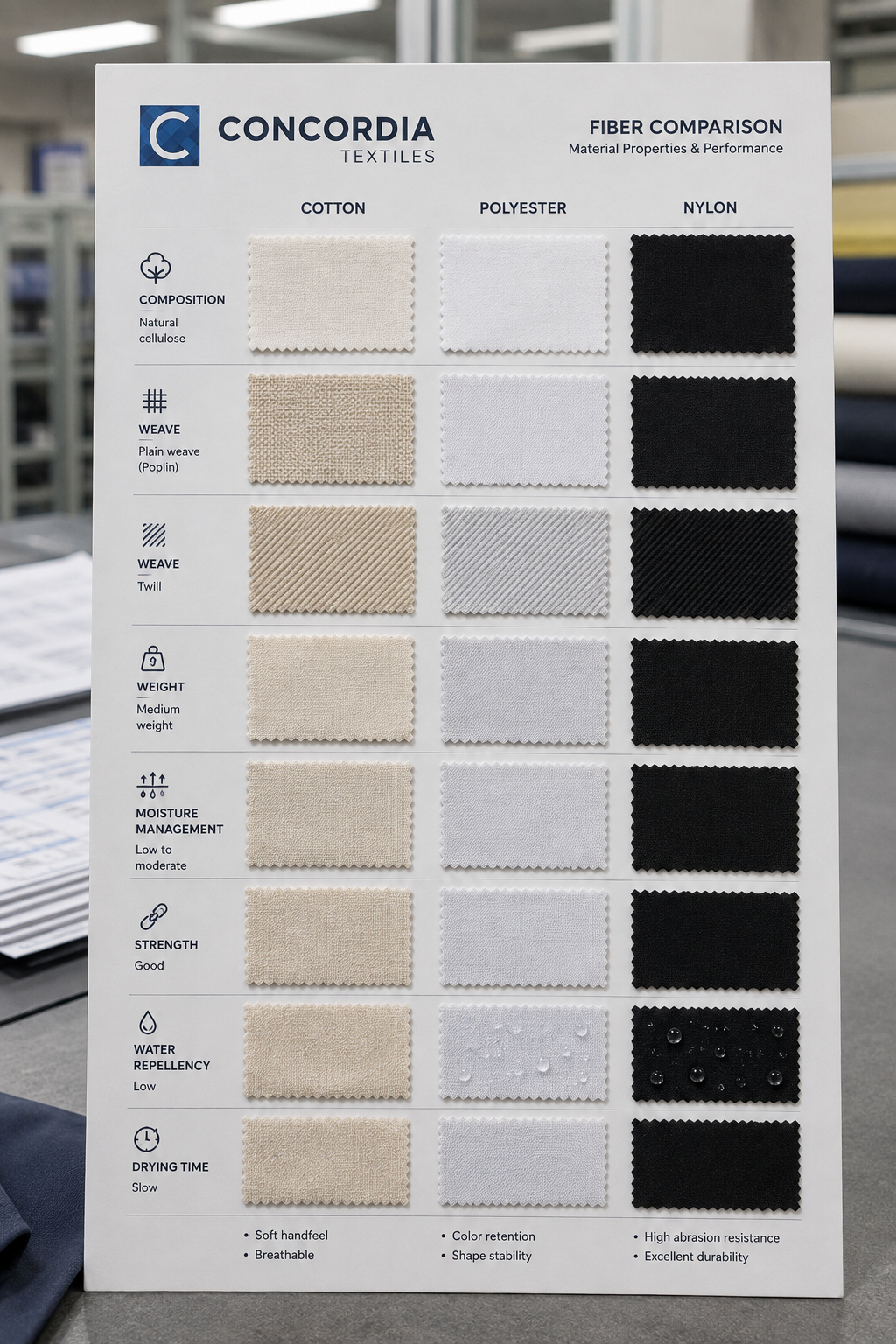
Cotton is breathable and moisture-wicking. Cotton wicks moisture, keeping skin cool in hot climates - essential in agriculture, food production and warm workplace environments. Cotton workwear can be washed at temperatures up to 95°C, making it suitable for hygiene-critical sectors. However, cotton alone offers lower abrasion resistance and slower drying compared to synthetic materials.
Polyester is known for its durability and wrinkle resistance. It forms the backbone of many durable workwear fabrics because it dries quickly, ideal for frequent cleaning environments, and retains colour far better under industrial laundry. Polyester cotton blends - typically 65/35 - are widely used in twill and canvas constructions. Polycotton blends provide better color fastness than 100% cotton, making them a practical combination for uniforms that must look professional wash after wash.
Nylon is lightweight and water-resistant, making it suitable for outdoor work in construction and agriculture where rain protection matters. Nylon is durable and abrasion resistant for daily use, which is why it appears in reinforcement panels at knees, elbows and seat. Its lower UV and chemical resistance compared to polyester limits its use as a primary shell in some environments.
The difference between weave types - plain, twill, ripstop - affects both performance and garment design possibilities.
Stretch and elasticity: Why some fabrics fail in industrial laundry
A new workwear uniform feels great in the fitting room. The stretch is smooth, the fit precise, freedom of movement is excellent. Then industrial laundry begins - and within weeks, the clothes lose shape, bag at the knees, and look worn. This is one of the most common and costly failures in workwear production today.
The root cause: standard cotton/polyester/spandex blends cannot survive 60–75°C industrial washing and tunnel drying. Spandex loses elasticity after 5–10 industrial laundry cycles. The thermal damage and mechanical breakage of elastane filaments causes fuzziness, bagging and complete loss of elastic recovery. Elastomeric stretch fabrics enhance comfort and mobility in workwear - but only if the elastic component survives the cleaning process.
The solution is increasingly clear. Elastolefin is the better option for industrial laundry while also having better chemical resistance and UV-resistance.
Another option for more comfort are mechanical stretch fabrics that use specialized weaving for flexibility and durability, offering another route. Stretch fabrics improve comfort for physical tasks, but only when specified for industrial laundry from the outset.
Water Resistance, Soil Release and Practical Comfort on the Job
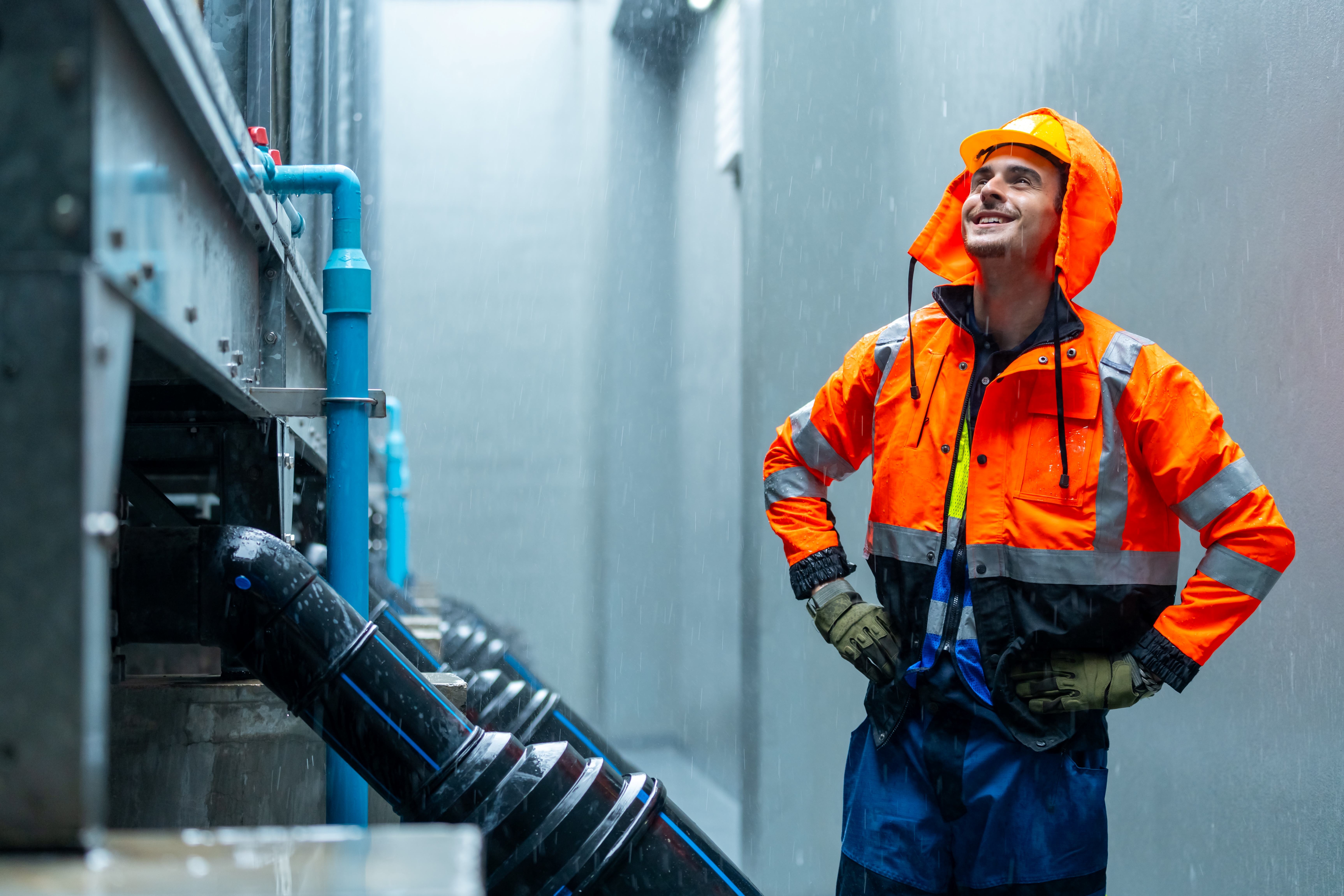
Water resistance and stain management are essential for outdoor and rough trades, but must be engineered without compromising washability or breathability. Workers in construction, agriculture and logistics need protection from rain and soil, but the garments also need to survive the laundry.
The difference between water-repellent finishes (such as DWR on polyester or nylon shells) and fully waterproof membranes matters under repeated washing. DWR finishes can lose performance after prolonged tunnel drying, while membranes may delaminate if not engineered for high heat. Fabrics are treated with coatings for chemical resistance in sectors like chemical and pharmaceutical industries, where chemical-resistant fabrics protect against corrosion and degradation. Workers must check fabric specifications for chemical resistance, and EN 13034 standard tests chemical splash protection in fabrics where relevant.
Multiple layered fabrics are useful in cold-weather workwear, but these too must be validated for industrial laundry. Designers can balance comfort and protection by using breathable back panels, stretch inserts in non-exposed zones, and strategic reinforcement on knees, elbows and seat.
Industrial laundry: Why EN ISO 15797 is the real durability test
Industrial laundry is fundamentally different from domestic washing. Higher mechanical action, strong alkaline detergents, temperatures typically between 60–85°C, and tunnel finishing or tumble drying create a far more aggressive environment. ISO 15797 tests simulate washing at 75°C and tunnel drying, providing a standardised framework for objective comparison.
After defined cycle counts (25, 50, 75, 100), fabrics are evaluated for dimensional stability, colourfastness, pilling and retention of protective performance.
For protective clothing, certified performance after washing is not optional - it is critical for safety and security. Flame-retardant clothing resists fire and prevents flames from spreading, and flame-retardant materials are crucial in high fire-risk sectors. EN ISO 11612 is a standard for flame-retardant fabrics, and compliance with safety regulations is essential for flame-retardant garments. Flame-retardant clothing can be a matter of life and death. After almost every product standard contains test standards that need to be performed after washing.
Avoiding costly mistakes: A buyer's checklist for durable workwear textiles
Most premature failures - shrinkage, loss of colour and broken stretch - can be prevented with structured sourcing. Here is a practical checklist:
- EN ISO 15797 test data is required when applicable - supported through certifications
- Confirm dimensional stability and colourfastness values after the target number of wash cycles for your programme.
- Check abrasion (Martindale) and tear performance at levels suitable for your workplace environment.
- Verify stretch recovery after multiple industrial cycles if the garment includes elastic fibres.
- Request fabric samples tested under your specific laundry conditions - temperature, chemicals, drying method.
- Avoid untested fashion fabrics, especially spandex-heavy blends not designed for industrial laundry.
- Collaborate early between workwear brand, fabric supplier and industrial laundry partner to validate wash programmes before large-scale production.
Poly-cotton blends balance comfort with quick-drying strength, but the exact blend ratio and finish must match your laundry's chemistry. Polyester is known for its durability and wrinkle resistance, but even polyester-based textiles need validation under the right conditions.
Want fabrics that hold up wash after wash?
Concordia validates every durable fabric against real industrial laundry conditions - not just lab claims.
Talk to our teamworkwear fabrics
Read more about this:
FAQ: Durable workwear textiles and industrial laundry
How many industrial wash cycles should quality workwear survive?
Expectations vary by sector, but serious rental and laundry partners often target at least 50 EN ISO 15797 cycles for standard workwear and 75–100 for premium or protective ranges. True performance means retaining colour, fit, comfort and any certifications throughout those cycles — not just surviving structurally. In sectors where garments must protect workers from heat or chemicals, even a slight drop in certified performance can mean the garment must be retired early, so these figures are not arbitrary.
Can I use the same fabrics for home washing and industrial laundry?
Most fabrics designed for domestic washing at 30–40°C are not suitable for industrial processes. Denim, for example, is a popular retail and light-weight workwear option but rarely survives aggressive industrial cycles without significant shrinkage and colour loss. If garments will pass through an industrial laundry at any point, the fabric should be selected and tested specifically against EN ISO 15797.
Does higher water resistance always mean better durability?
Not necessarily. Heavy coatings or membranes can improve weather protection but may crack, delaminate or lose performance if not engineered for high-temperature washing and tunnel drying. Choose solutions explicitly tested for your intended industrial laundry setup rather than maximising lab water column values that cannot be maintained in real use.
How do I know if my current garments are failing because of fabric choice or laundry process?
Issues like severe shrinkage, colour bleeding or loss of stretch can stem from either inadequate fabric specification or overly aggressive wash programmes. Conducting controlled EN ISO 15797 wash tests alongside a review of the laundry's chemistry, temperatures and mechanical action is the most reliable way to identify the root cause.
Is investing in EN ISO 15797-tested fabrics really more cost-effective?
While such fabrics often carry a higher price per metre, they typically reduce replacement frequency, logistics costs and customer complaints — lowering cost per wear over a 3–5 year contract. Simple cost-per-wear and lifetime value calculations in tenders and sales materials make this case clearly.
