
PU Membrane vs PTFE Membrane (Plus PES & TPU): Which Breathable Membrane Do You Really Need?
Choosing between a PU membrane and a PTFE membrane is one of the most common decisions facing buyers of waterproof, breathable materials. But PES and TPU deserve a place in that conversation too. This article compares all four membrane types on waterproofness, breathability, price and application so you can select the right product for your project.
Key Takeaways
- Buyers mainly compare PU vs PTFE membranes, yet PES and TPU are important alternatives for specific sectors including outdoor clothing, medical devices and industrial filtration.
- Breathable membranes are water-resistant but vapour permeable - they allow water vapour to escape while keeping rain, snow and wind out. A vapour control layer serves a different function: it sits on the warm side of insulation and restricts vapour movement into the structure.
- PTFE/ePTFE generally delivers the highest long-term waterproofness and breathability, but at a premium price. PU and TPU are mid-range all-rounders. PES is cost-effective for less demanding applications.
- Your choice should be driven by four criteria: waterproof rating (hydrostatic head), breathability (Ret), price per m², and intended use.
PU, PTFE, PES & TPU Membranes at a Glance
Several membrane technologies are used in waterproof and breathable fabrics, each offering a different balance of protection, comfort, durability, and cost. The most common membrane families found in technical apparel and workwear are polyurethane (PU), expanded polytetrafluoroethylene (ePTFE), polyester (PES), and thermoplastic polyurethane (TPU).
While all of these technologies provide a barrier against liquid water, their performance characteristics and typical application areas differ considerably.
- PU (Polyurethane)
PU membranes are the most widely used solution in waterproof-breathable textiles. They offer an excellent balance between waterproof protection, breathability, flexibility, and cost efficiency. Thanks to their versatility, PU membranes can be found in outdoor apparel, workwear, footwear, and protective clothing across a wide range of performance levels. - ePTFE (Expanded Polytetrafluoroethylene)
ePTFE membranes are typically used in high-performance and premium applications where maximum waterproofness, breathability, durability, and chemical resistance are required. They are commonly found in technical outdoor garments, protective clothing, and specialised industrial applications. - PES (Polyester)
Polyester-based membranes are used in selected applications where dimensional stability and cost-effectiveness are key considerations. Although less common than PU or ePTFE, they can offer a suitable solution for specific performance requirements. - TPU (Thermoplastic Polyurethane)
TPU membranes and films are known for their elasticity, durability, and abrasion resistance. They are often used in footwear, sportswear, protective equipment, inflatable structures, and applications where flexibility is a critical performance requirement.
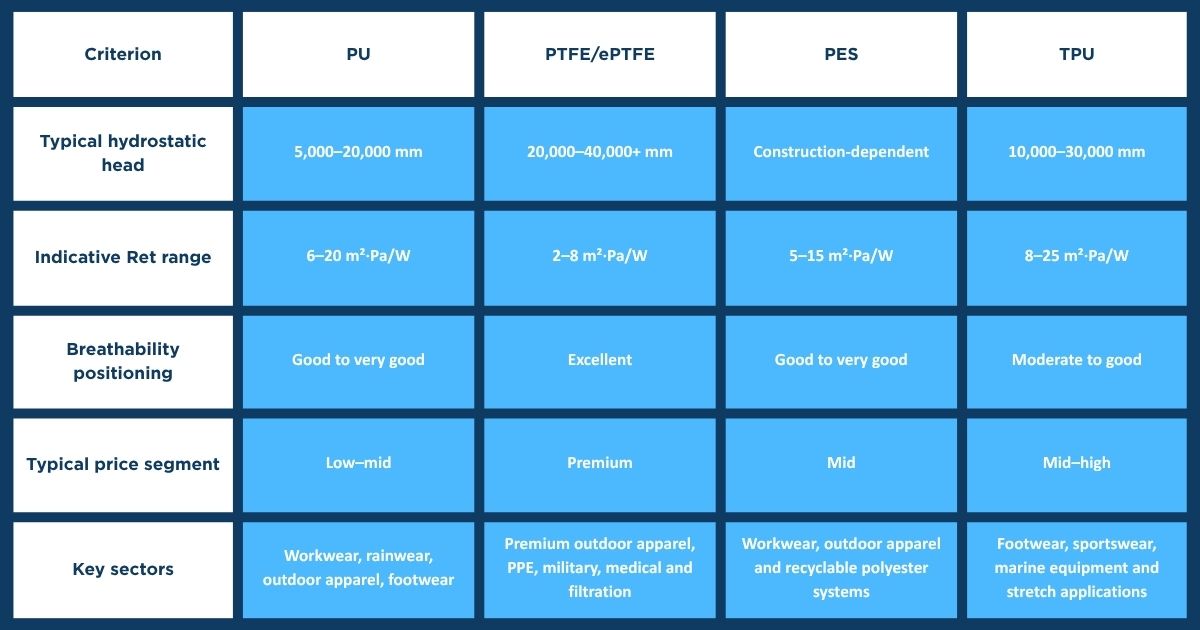
*Indicative values only. Ret is measured according to ISO 11092 and expresses resistance to evaporative heat transfer. A lower Ret value indicates better breathability. The final result depends on the complete fabric construction, including the face fabric, membrane thickness, adhesive application, lamination method, backing fabric and finishing.
Waterproofness: How PU, PTFE, PES and TPU Compare
Waterproofness is usually expressed as hydrostatic head in mm H₂O, measured according to standards such as ISO 811. Building and garment standards in Europe generally look for values above 10,000–20,000 mm for demanding exposure to rain, wind and snow.
- PU membranes are widely used in technical apparel, workwear and outdoor products. Typical waterproof ratings range from 10,000 to 20,000 mm, although higher values are achievable depending on the construction. PU offers an excellent balance between waterproofness, breathability, flexibility and cost. As a hydrophilic membrane, performance can be affected over time by factors such as hydrolysis, prolonged humidity exposure and aggressive environmental conditions.
- PTFE/ePTFE membranes are commonly used in premium outdoor, protective and technical garments. Their microporous structure provides very high waterproofness, often exceeding 20,000–30,000 mm, while maintaining excellent moisture vapour transmission. ePTFE is valued for its exceptional chemical resistance, thermal stability and long-term durability when adequately protected within a laminated construction.
- PES membranes are used in selected applications where dimensional stability, durability and compatibility with polyester-based laminates are important. Waterproof performance depends strongly on the membrane design and laminate construction, but typically falls within the same performance range as PU membranes. PES solutions are often chosen for specific product concepts, including recyclable mono-material systems, rather than purely for maximum waterproof performance.
- TPU membranes deliver robust waterproof protection, typically ranging from 10,000 to 30,000 mm depending on the application. Their continuous, non-porous structure provides excellent resistance to water penetration while offering outstanding elasticity, abrasion resistance and mechanical durability. TPU is therefore widely used in footwear, sportswear, protective equipment and applications where flexibility is essential.
Breathability: Managing Moisture and Comfort
Breathability refers to a membrane's ability to transport moisture vapour away from the body while maintaining protection against external water. This is a key factor in wearer comfort, particularly in workwear, outdoor apparel and protective clothing where physical activity can generate significant heat and moisture.
Breathability is commonly expressed as either MVTR (Moisture Vapour Transmission Rate, g/m²/24h) or Ret (Resistance to Evaporative Heat Transfer, ISO 11092). While MVTR is often used in marketing communications, Ret is generally considered the more reliable indicator for comparing comfort. Lower Ret values indicate better moisture vapour transport.
- PU (Polyurethane): Most PU membranes used in technical textiles are hydrophilic and transport moisture through molecular diffusion rather than through pores. This technology provides a good balance of waterproofness, breathability, flexibility and durability. Performance depends strongly on the membrane design and laminate construction, with typical breathable laminates achieving Ret values between 6 and 20 m²·Pa/W.
- ePTFE (Expanded Polytetrafluoroethylene): ePTFE membranes use a microporous structure that allows water vapour to pass while preventing liquid water penetration. This technology is widely used in premium outdoor and protective garments due to its combination of high waterproofness and excellent breathability. Well-designed ePTFE laminates typically achieve Ret values below 10 m²·Pa/W, making them among the most breathable waterproof systems available.
- PES (Polyester): Polyester-based membranes are used in selected textile applications where dimensional stability, durability or mono-material design concepts are important. Breathability performance depends on the specific membrane technology and laminate construction rather than on the polyester chemistry itself. As a result, PES membranes can achieve a wide range of moisture management properties depending on the application.
- TPU (Thermoplastic Polyurethane): TPU membranes are valued for their elasticity, durability and mechanical resistance. Depending on their formulation and structure, TPU membranes can provide moderate to good breathability while maintaining excellent waterproof protection. They are commonly used in footwear, sportswear, stretch garments and applications where flexibility is a key requirement.
Comparing Breathability
There is no single membrane technology that is best for every end use. While premium ePTFE laminates generally offer the highest breathability, modern PU, TPU and PES-based systems can also deliver excellent wearer comfort when properly engineered. In practice, overall performance depends not only on the membrane itself, but also on factors such as the face fabric, lining, lamination technology and garment construction.
Typical breathability ranking (finished laminate):
ePTFE → Advanced PU systems → PES membranes → TPU membranes
However, significant overlap exists between technologies, and a well-designed PU laminate can outperform a poorly designed ePTFE system in real-world use. For this reason, breathability should always be evaluated at the fabric or garment level rather than based on membrane chemistry alone.
Price and Lifetime Cost: Balancing Budget vs Performance
Price and Lifetime Value: Looking Beyond Initial Cost
When selecting a membrane technology, the purchase price is only one part of the equation. Long-term value is influenced by factors such as durability, maintenance requirements, garment lifespan, wearer comfort, warranty claims and overall performance retention throughout the product's service life.
- PU (Polyurethane): PU membranes are generally the most cost-effective solution and therefore represent the largest share of the waterproof-breathable apparel market. They offer an attractive balance of waterproofness, breathability, flexibility and affordability, making them suitable for a wide variety of workwear, outdoor and protective applications. For many products, PU provides the best overall value proposition by delivering reliable performance at a competitive cost.
- ePTFE (Expanded Polytetrafluoroethylene): ePTFE membranes are typically positioned in the premium segment due to their advanced performance characteristics and complex manufacturing processes. They are often selected for high-end outdoor, military, professional and protective garments where maximum waterproofness, breathability and long-term performance are critical. In demanding applications, the higher initial investment may be justified by the extended service life and consistent performance over time.
- PES (Polyester): Polyester-based membrane solutions can offer advantages in applications where material compatibility, durability or mono-material design concepts are important. Cost positioning varies depending on the specific membrane technology and laminate construction. Rather than competing solely on price, PES systems are often selected to support specific sustainability, recyclability or product-design objectives.
- TPU (Thermoplastic Polyurethane): TPU membranes typically occupy the mid- to high-performance segment. While generally more expensive than standard PU solutions, they provide excellent elasticity, abrasion resistance and mechanical durability. These characteristics can contribute to a longer product lifetime in demanding applications such as footwear, sportswear and technical protective products, where flexibility and robustness are key requirements.
Choosing the Right Value Proposition
There is no universally "best" membrane from a cost perspective. The most economical choice depends on the intended application, performance requirements and expected product lifetime. In many cases, evaluating the total value of the finished fabric or garment, rather than the membrane cost alone, leads to better product decisions and improved end-user satisfaction.
For this reason, membrane selection should consider the balance between:
- Initial material cost
- Waterproof and breathable performance
- Durability and ageing behaviour
- Comfort and wearer acceptance
- Sustainability objectives
- Expected service life of the garment
Ultimately, the most successful fabrics are those that deliver the required performance level at the most appropriate total cost of ownership for the end use.
Applications by Sector: Where Each Membrane Type Excels
While membrane technologies are often compared based on waterproofness or breathability alone, the most important selection criterion is ultimately the intended application. Different industries place different demands on fabrics, whether that is durability, comfort, flexibility, weight, sustainability or long-term performance in challenging environments. As a result, no single membrane technology is universally superior; each offers advantages for specific end-use requirements.
PU (Polyurethane)
PU remains the most widely used membrane technology in workwear, outdoor apparel, rainwear and corporate clothing. Its combination of reliable waterproofness, good breathability, softness and cost efficiency makes it suitable for a broad range of garments. PU-based laminates are frequently selected when comfort, versatility and value are the primary drivers.
ePTFE (Expanded Polytetrafluoroethylene)
ePTFE membranes are typically found in premium outdoor apparel, military garments, emergency services clothing and high-performance protective wear. These applications benefit from the combination of exceptional waterproofness, high breathability and long-term durability, particularly in demanding environmental conditions.
PES (Polyester)
Polyester-based membrane solutions are increasingly considered for applications where material compatibility, durability and recyclability objectives are important. They can support mono-material or polyester-dominant constructions and are therefore attracting interest in sectors where circularity and end-of-life considerations are becoming more important.
TPU (Thermoplastic Polyurethane)
TPU membranes are commonly used in footwear, sportswear, stretch garments, soft equipment and technical protective products. Their high elasticity, abrasion resistance and mechanical strength make them particularly suitable for applications that require flexibility and durability under repeated movement and stress.
Matching Technology to Performance Requirements
In practice, membrane selection is rarely based on a single performance parameter. Fabric developers and garment brands typically evaluate waterproofness, breathability, durability, flexibility, sustainability objectives and cost simultaneously. The most successful solutions are therefore those where the membrane technology, textile construction and final application are carefully aligned.
For this reason, fabrics should not be viewed as "PU fabrics" or "ePTFE fabrics" alone. The overall laminate design, including face fabric, membrane, backing fabric, lamination technology and finishing, ultimately determines how the product performs in the field. A well-engineered membrane system tailored to the application will consistently outperform a solution selected solely on material type.
FAQ: PU vs PTFE and Other Membrane Choices
These FAQs address practical questions buyers often raise after reading a PU vs PTFE comparison.
Is a PTFE membrane always better than a PU membrane?
Not necessarily. PTFE/ePTFE usually wins on maximum breathability, long-term waterproofness and chemical resistance, but PU can be more than sufficient for everyday waterproof jackets, mid-range breather membranes and cost-sensitive projects. Weigh climate, user activity level, expected lifetime and budget rather than choosing on material name alone.
Which membrane type is most suitable for very cold, dry climates?
In cold, dry environments both PU and PTFE membranes can perform well, but PTFE/ePTFE often provides more consistent breathability when users produce a lot of sweat during high-intensity winter sports. For building envelopes, highly breathable roofing membranes based on PES/PU or PES/PTFE laminates help moisture escape efficiently while retaining insulation performance and reliable protection against dust and debris driven by cold wind.
How do I compare breathability values between different manufacturers?
Comparing breathability data can be challenging because manufacturers often use different test methods and reporting standards. To make a meaningful comparison, it is essential to verify both the measurement method and the test conditions before evaluating performance figures.
Breathability is most commonly reported as either:
- MVTR (Moisture Vapour Transmission Rate), expressed in g/m²/24h and measured according to standards such as ASTM E96 or JIS L 1099.
- Ret (Resistance to Evaporative Heat Transfer), measured according to ISO 11092, where lower values indicate better breathability.
Because different MVTR test methods can produce significantly different results for the same fabric, direct comparison between values generated using different standards is not recommended. For this reason, many technical textile professionals consider Ret measurements according to ISO 11092 to be one of the most reliable indicators of wearer comfort and moisture management.
When comparing fabrics from different suppliers, always:
- Compare results obtained using the same test method.
- Verify whether values refer to the membrane itself, the laminate, or the finished garment.
- Consider waterproofness, durability and comfort together rather than focusing on breathability alone.
- Request independent test reports or certification data where available.
It is also important to recognise that terms such as "highly breathable", "exceptional comfort" or "advanced moisture management" are marketing descriptions rather than standardised performance classifications. Objective test data remains the most reliable basis for evaluating and comparing waterproof-breathable fabric systems.
In practice, the best comparison is achieved by reviewing both Ret and waterproofness results, as a well-designed laminate balances moisture vapour transport with reliable protection against rain and environmental exposure. A fabric with excellent laboratory breathability but insufficient waterproof performance may not provide the best solution for the intended end use.
Are PES-based breathable membranes environmentally better than PTFE or PU?
PES is widely recyclable and often partly derived from recycled sources. ePTFE membranes are recyclable, unlike standard PTFE membranes, but recycling infrastructure remains limited. Longer service life of PTFE membranes can offset their higher environmental impact per m². A recent academic study showed fluorine-free PES-based alternatives approaching ePTFE performance after weathering. Sustainability assessments should measure the full life cycle - production, usage, durability and end-of-life - rather than assuming one polymer family is always the greener solution.
Not sure which membrane fits your team's working conditions?
Talk to our team about your specific use case - we'll help you match the right coating or membrane technology to your real working conditions, not just a spec sheet.
